
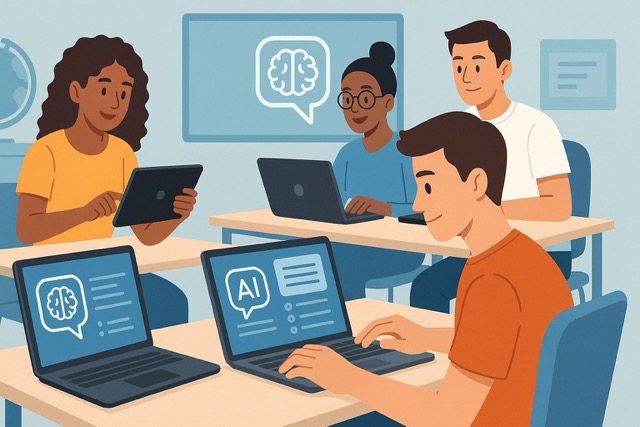
As a student today, you’re part of the first truly global classroom powered by artificial intelligence. Whether you’re studying in Dhaka, Düsseldorf, or Denver, AI is reshaping how you learn, communicate, and prepare for the future. What used to require hours of manual work—editing essays, organizing notes, or understanding difficult concepts—can now be streamlined with intelligent tools. This article takes you around the world to show how students like you are using AI to personalize education, collaborate across borders, and develop skills that matter in tomorrow’s job market.
Custom Learning Paths Through AI Assistance
Your learning no longer has to follow a rigid, one-size-fits-all structure. AI has opened the door to tools that adjust in real-time to your pace and style. If you’re using apps like Khan Academy’s AI tutor or ScribeSense, you’re benefiting from adaptive systems that guide your progress, offer feedback, and keep you engaged. In India, high school students preparing for the Joint Entrance Exam (JEE) are relying on personalized AI coaching to target their weak spots, a strategy that’s proven to boost retention and reduce test anxiety.
At the university level, you can use tools like Notion AI or ChatGPT to break down complex readings, ask clarifying questions, or organize study notes. Instead of spending your entire evening decoding a dense textbook chapter, AI lets you focus on critical thinking and application. The more data you give these tools through interaction, the more tailored their support becomes. It’s like having a personal tutor that works at your schedule—without the cost.
Boosting Academic Writing and Research Efficiency
Writing papers or structuring research can often feel overwhelming, especially when you’re juggling deadlines. This is where AI tools can support your workflow. Tools like Grammarly and Jasper not only correct grammar but also suggest style changes and tone adjustments based on your purpose. In Germany, universities have reported a surge in student use of AI writing assistants for improving English essays. You still do the thinking, but the tech helps you polish your output faster.
You’re also likely using AI to organize references or run fact-checks. Zotero, ResearchRabbit, and Elicit use machine learning to suggest sources, summarize academic papers, and identify gaps in your arguments. With so much content available, knowing what to read matters just as much as how fast you read it. These tools help you narrow down the noise and focus on quality material. Instead of clicking through 20 tabs, you can zero in on what supports your thesis.
Real-Time Translation and Global Collaboration
Whether you’re attending virtual exchange programs or working on joint projects with peers abroad, AI is removing communication barriers in ways that weren’t possible even five years ago. Real-time translation tools like DeepL or Google Translate are no longer clunky—they’re embedded into learning management systems and communication platforms. In Latin America, bilingual classrooms are using AI-driven subtitles to support simultaneous instruction in multiple languages.
You can now collaborate on shared documents with students in different countries while each person sees content in their preferred language. AI enables this without slowing down the process. When you submit group work or exchange research summaries, tools like Otter.ai transcribe and organize discussions so that no idea is lost. These features don’t just make communication easier—they make global education possible without needing to be fluent in six languages.
Smarter Scheduling and Academic Organization
Balancing classes, part-time jobs, and extracurriculars can feel like a puzzle. AI-integrated calendars and productivity apps now help you manage it all. Whether you’re using Motion, Google Calendar with AI integrations, or Reclaim.ai, you’re no longer just setting reminders. You’re getting suggested study slots, flagged deadlines, and automatic rearrangement based on priority or energy levels. Students in South Korea are using similar systems to handle packed tutoring schedules, university lectures, and exam prep in a more efficient flow.
Some apps go a step further by syncing with your syllabi. If you feed your course outline into your calendar app, it can build an automatic roadmap to prep you for midterms, flag upcoming group meetings, and set aside buffer time for revisions. You can stop reacting and start planning with confidence, knowing your system is already thinking ahead for you.
AI Tutoring That Feels Personal
In regions where traditional tutoring is expensive or inaccessible, AI tutors are filling the gap. Tools like Sora (in Africa) and PrepAI (in Asia) offer interactive exercises, video explanations, and even voice-to-text feedback. These tools are growing popular in remote and rural areas where educational infrastructure is stretched thin. As a student in these settings, you get access to academic support that was once limited to wealthier districts.
Unlike generic tutorial videos, AI tutors respond to your inputs. They adjust their explanations based on your pace, skip what you already know, and review what you’re missing. You’re not just watching content passively—you’re shaping your learning journey by interacting with the material. That level of engagement saves time and improves your confidence when it’s time to take the test.
Ethical Use and Digital Integrity
With all these tools at your fingertips, you also have the responsibility to use them wisely. Schools across the globe are catching up by introducing clear guidelines around AI usage. In the U.S., universities like Stanford and Duke are establishing boundaries for when it’s acceptable to use AI in coursework—and when it becomes academic dishonesty. You’ll likely be asked to cite AI tools or include disclosure statements if they assisted in your research or writing.
If you’re navigating unclear rules, use a common-sense filter: is this tool helping you learn or doing the learning for you? Relying on AI to spark ideas, structure your outline, or correct grammar is one thing—submitting AI-generated work as your own is another. The point is to amplify your ability, not replace it. That distinction matters, especially as employers start asking how you’ve used AI tools to solve problems creatively, not just cut corners.
Most Popular AI Tools Used by Students
- Khan Academy AI – interactive problem-solving tutor
- Grammarly – writing clarity and grammar corrections
- ChatGPT – structured study aid and content helper
- Otter.ai – live transcription for classes and meetings
- Notion AI – smart workspace for organizing notes and tasks
Preparing for an AI-Driven Workforce
You’re not just using AI to get through school—you’re building skills that employers are watching closely. Many of today’s industries expect you to be comfortable with tools that involve automation, prompt-based querying, and digital coordination. By experimenting with AI in your coursework now, you’re gaining real-world experience that translates into job-readiness. Fields like marketing, logistics, health sciences, and engineering all reward early familiarity with smart tools.
More importantly, you’re learning how to think critically about technology. You get to assess what makes an AI response useful, how to improve it, and when it’s not enough. That mindset—curiosity mixed with discernment—is one of the most valuable assets in the job market. You’ll be ahead of the curve not just because you used AI, but because you knew how to use it well.
In Conclusion
Around the world, you and your peers are using AI not just to make education easier but to make it smarter. Whether it’s refining your writing, managing your time, or connecting across cultures, AI is giving you an edge—one that’s measurable, flexible, and future-focused. The key is to use these tools responsibly, staying alert to both their power and their limits. You’re not just preparing for tests anymore; you’re preparing for a world where your ability to use and understand AI will be just as important as anything on your transcript.
Looking for visually engaging content and curated collections on education, technology, and more? You can explore my Pinterest.

Jared Ailstock is Managing Partner at AIP Capital with over 15 years of experience in aviation finance and investment. He specializes in global aviation strategy, asset-backed transactions, and sustainable growth across the aerospace industry.